
By Amber Weigand-Buckley

I’ve lost my AirPods more times than I can count.
My phone? Found later tucked into my sports bra strap. My car? Somewhere in a parking lot, more often than I care to admit.
I’ve missed turns I take every week because my brain locked onto a thought and coasted past my own exit—recalculating, like a GPS that freezes every single time.
But the one that started it all: I bought new glasses on a Friday. Found my old ones Sunday—in the washing machine. Not near it. Inside it. Gone through who knows how many cycles while I stood right in front of it, loading laundry, completely missing them.
That’s my brain. Maybe it’s yours too.
52 Years to Get the Words Right
It took me 52 years—over 5 decades—to understand why.
Why I got in trouble as a kid for not sitting still. Why no planner, app, or color-coded system ever stuck. Then somebody finally gave me the right words: neurodivergent. ADHD. Not a character flaw. A different wiring—not broken, just different.
A nuance worth knowing: some of what looks like ADHD is wiring you were born with. Some of it is a body stuck in fight-or-flight, mimicking the same symptoms. Either way—not lazy, not broken. Just dysregulated or different. Both deserve compassion. This is why I call this whole journey “I fear how I’m wonderfully made.”
Psalm 139 says I’m fearfully and wonderfully made, and for most of my life I thought if this is wonderful; then God your definition of wonderful is not what it’s cracked up to be. I felt like my quirks were too much for myself, let alone anyone to deal with. But what I found is you can be afraid of how you’re made and still be exactly, deliberately made that way.
The Same Brain That Builds Also Breaks
You see, my hap-hazard brain that loses everything is the same one that sees connection in everything.
I can also see an idea and execute it almost in the same breath, barely a gap between “I should” and “I did.” That’s a gift.
On a bad day, it’s also a curse: the same speed that builds fast also misses turns and jumps before it thinks.
The Friends I Keep on the Other Side of the Glass
I’m real about my struggles—I’ll tell you the truth about my brain faster than most people ask for it.
But even people who think they know me usually get an edited version, because the full Amber is a huge investment. ADHD people don’t do anything halfway, including connection—we go one-on-one which can be too close for comfortable sanity level.
So I keep most people behind the glass, not because I don’t want closeness, but because the full, unfiltered version of me costs something for both of us. And frankly I don’t want to risk that much when I’m in spaghetti’d thought. I can send a manic string of texts back-to-back that I end up deleting just as fast, like a mad woman, because I should have controlled how I presented myself. I’ve worn out friends and worn out my own capacity trying not to wear out theirs.
Three Things That Actually Stick
ADHD doesn’t respond to “just stop it.” It responds to small, repeatable anchors:
1. Give your stuff a landing spot—maybe one bowl by the door for keys, AirPods, your phone. Not for tidiness; it removes a decision you don’t have bandwidth for ten times a day. I have a box on my desk for everything now that my back door opens right into my office.
2. Build in a pause before you react—one breath, hand on your chest, before responding to anything that feels urgent. Half the time, it’s just loud, not urgent.
3. Pick one phrase and return to it on repeat. Mine is the simplest prayer, “Jesus, help me.” You don’t need a new strategy every day—just the same true thing, enough times, until it sticks.
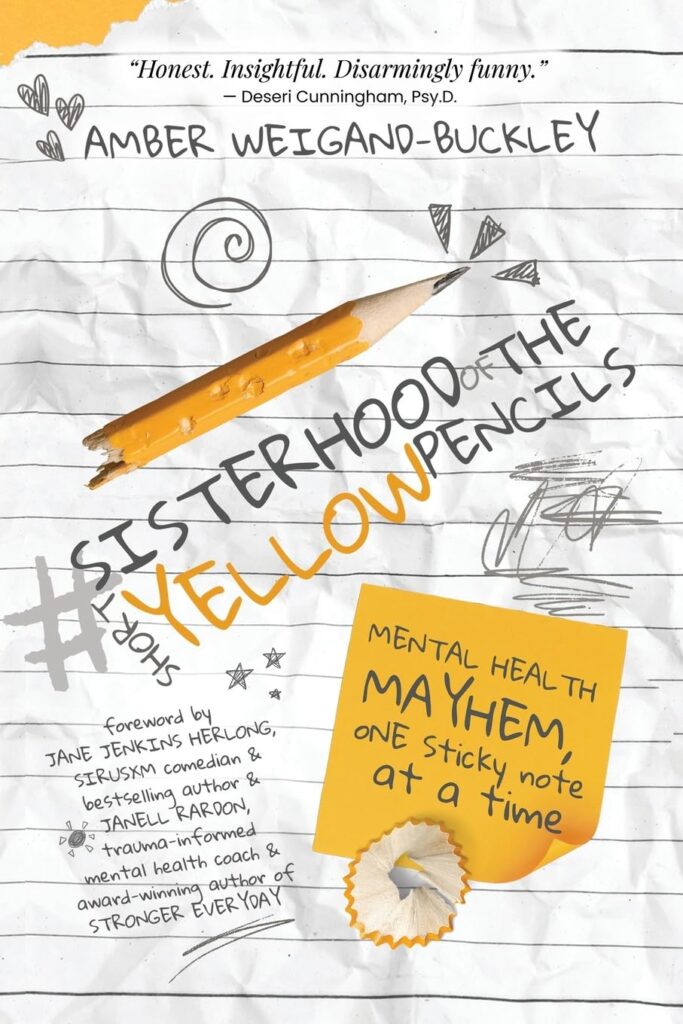
It took me half a century to stop apologizing for my brain. You don’t have to take that long.
My universe still lives on the tip of a #shortyellowpencil (you’ll have to read my very neuro-spicy book to really get that whole reference in all its hilarity)—the same small place that holds my capacity, my mess, and my washing machine, AirPods, missed-turn kind of days.
But whether I’m operating in the strength or the weakness of my God-breathed DNA, He is always there for me. And He’s there for you too—because He designed us, on purpose, for Him to pick up what we lack.
AMBER WEIGAND-BUCKLEY—a #shortyellowpencil girl living in a neurotypical world—is an Amazon #1 bestselling, award-winning author and founding editor of Leading Hearts magazine. Her new book, #SisterhoodoftheShortYellowPencils: Mental Health Mayhem One Sticky Note at a Time, is ultimately a book about capacity—what happens when yours runs out faster than everyone else’s, and why that was never something to be ashamed of. She hosts multiple podcasts including #RandomDevoThoughts and lives in Springfield, Missouri.