
By Amber Weigand Buckley

There’s a PTSD-inducing flashback in my brain that keeps showing up in the most inconvenient moments.
Picture this: My senior year of high school. The ACT. A No. 2 pencil. A Scantron sheet full of little bubbles just begging to become something other than test answers.
So I short-yellow-penciled my way through that test with neurodivergent flair—avoiding doing any actual work by making dot-to-dot flowers, a random smiley face that could be built in Minecraft, words that looked like Morse code. I guess I got bored.
Or maybe I didn’t have all the answers and they were trying to force me into little boxes and my brain said, “Nah, let’s make a meadow instead.” Final score: 19.
That’s not a brag. That’s a paradox I’ve been living my whole life—the tension between what I was trained to be and who I actually am.
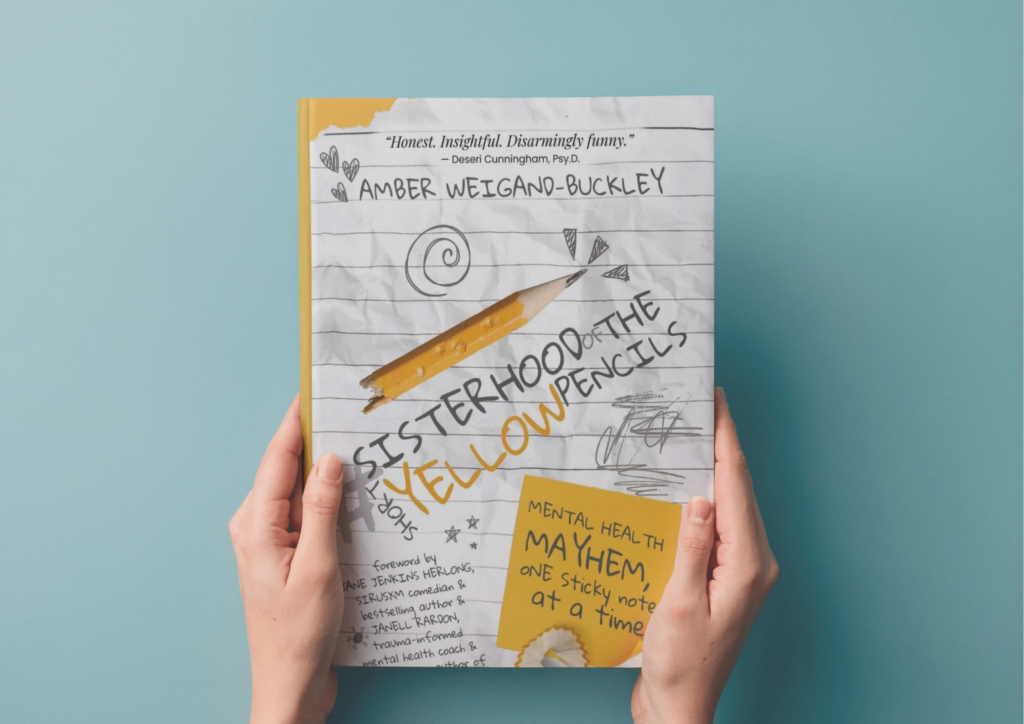
Between the rules I know and the people I’m called to reach. The PTSD-inducing part? Actually ending up paying tuition money for that “we’re not sure you should have a high school diploma” Study Skills class. Fast forward to the final stretch of writing my book #sisterhoodoftheshortyellowpencils—Mental Health Mayhem, One Sticky Note at a Time, an extremely loose-leafed defined memoir for the brain that runs like squirrels on espresso.
I found myself in what I can only call procrastinative contemplation—that muddy space where you’re half paralyzed, half processing, fully convinced you could actually be losing your mind. Every copyedit became a theological crisis. My neurotypical editor would flag something, and I’d have to ask: Is this where I need to grow as a communicator, or is this where I’m being asked to shrink my message to fit a mold that was never built for the people I’m trying to reach?
I had to chew on every single edit like I’d never chewed before—in the framework of heaven, in the context of my calling, in the reality that my audience thinks in hashtags and parentheses because their thoughts run together and refuse to stay in one place.
The Mud Bath Nobody Warned Me About (How Procrastinative Contemplation Almost Drowned Me)
Here’s the thing: I almost gave up.
Not because I didn’t know what I wanted to say, but because I got stuck between wanting to be teachable and knowing I had a mission that didn’t fit the template. It felt like sinking into a mud bath—uncomfortable, a little dirty, and I wasn’t sure if I was being cleansed or suffocated. But I had to sit there. I had to type out the conversations in my head. I had to let the discomfort do its work.
Because somewhere in that muck, I realized: We can sit in the posture of teaching more than we sit in the posture of listening. We can focus on educating people into our way of speaking rather than asking, When does education mean we need to re-evaluate how we’re communicating to the people meant to receive it?
For me, it meant keeping the parentheses. The dashes. The metaphorical hodgepodge. Not because I couldn’t learn to write differently—I have the degree, I know the rules, I’ve won awards for honoring other people’s voices—but when it came to MY book, MY voice, MY mission? Following those rules would have wrapped my message in a format that never reaches the people wandering outside, convinced they’ll never have the chops to come in.
Teaching vs. Listening (What Jesus Knew About Meeting People Where They Are)
Jesus didn’t enter culture as a classically trained scribe.
He told stories about lost coins and wayward sons—parables that probably sounded neurodivergent to the religious establishment. Bouncing from subject to subject. Landing truths in metaphors that made the learned scratch their heads while the masses said, “Oh! I get it!”
He broke Sabbath conventions to heal. He ate with the wrong people. He learned how people spoke, then built frameworks they could walk in. That’s what I was wrestling with. The message was worth saying—but only if I said it in a way that the people who needed it could actually receive it.
The One > The Algorithm (Why I’m Done with All That)
Here’s where I have to be honest: My goal in life isn’t to reach everyone. God wired me to reach the one—the person sitting in the field who’s been told their whole life that if they’d just focus better, organize more, try harder, they’d be fine.
The person who thought, I should be over this by now, only to discover they didn’t outgrow it.
If I can show one person they’re part of a greater community—a #sisterhoodofshortyellowpencils who travel together because we don’t do this alone—then I’ve done my job.
What Getting into Good Trouble Actually Looks Like:
• You’re seeking to understand the people outside the room more than you’re worried about being understood by the people already in it
• You stop watering down your message to make everyone happy—because that just makes it weak for the person who actually needs to hear it
• You trust that your voice, exactly as it is, writes the story someone else desperately needs to read
Welcome, Fellow Kingdom-Purposed Weirdos (Bring on the Critics)
We have to be OK with being misunderstood if it means reaching the person God called us to reach.
We have to be OK with critics and people who think we’re breaking too many rules. Because here’s the truth: I am a divine rule-breaker. I was designed to meet a certain community where they are, and some of those traditional rules just don’t apply when you’re trying to go where God’s called you to be.
That doesn’t mean chaos for chaos’s sake. It means good trouble—intentional rule-breaking with the goal of wrapping arms around the overlooked and saying, You’re not alone. Welcome to the sisterhood. Short yellow pencils. No erasers. Very little surface left to chew on. But still instruments. Still writing stories that need to be told.
Maybe the faithful thing isn’t to sharpen everyone into No. 2 pencils. Maybe it’s to recognize that different instruments write different stories—stories that God is authoring one divine rule-breaker at a time.